Craftsmanship is a word that has been worn smooth by advertising, and I am wary of it for that reason. So rather than argue for it, let me describe what actually happens here between the day someone walks in and the day they collect a finished garment. The case makes itself, or it does not.
It starts as a conversation, not a measurement
The commission appointment runs forty-five minutes, and the measuring is the shortest part of it. Most of that time goes on questions that sound tangential: what your week actually looks like, which rooms you walk into, whether you drive or fly, whether you carry a bag on one shoulder, what you own that you reach for without thinking, and what you own that you never touch.
That last question is the useful one. Everybody has a jacket they never wear, and the reason is almost never the reason they give. It is rarely the colour. It is usually that it pulls somewhere, or that it makes them feel like they are wearing a costume, and they have never had the vocabulary to say so.
The measurements themselves are the easy part. What is difficult, and where the hours go, is reading a body — how someone stands, where they carry their weight, which shoulder is lower, whether the head sits forward, whether the back is straight or rounded. Two people with identical tape measurements need meaningfully different patterns, and nothing in the numbers will tell you that.
The pattern is the garment
Everything downstream is determined at the pattern table, where Mara works. A bespoke pattern is drafted for one body and no other — that is the literal meaning of the word, which originated on Savile Row and means to be spoken for: a garment claimed by a person before it exists.
This is where bespoke separates from made-to-measure, and the distinction gets blurred often enough to be worth stating plainly. Made-to-measure starts from an existing block and adjusts it within the limits of what that block can do. A bespoke pattern starts from paper and a person. It can accommodate things a block simply cannot — a genuinely uneven shoulder, a forward-set neck, a chest that is not the shape the industry has agreed chests are.
That paper pattern is also kept. It is a record of a specific person at a specific point in their life, and everything made afterwards starts from it rather than from scratch.
Three fittings, and why none is optional
A commission runs through three fittings after the first appointment, and each exists to catch a different class of problem.
- The scrap fitting proves the paper pattern in inexpensive fabric before your cloth is cut. Mistakes are inevitable at this stage; the entire point is that they happen on material nobody paid for
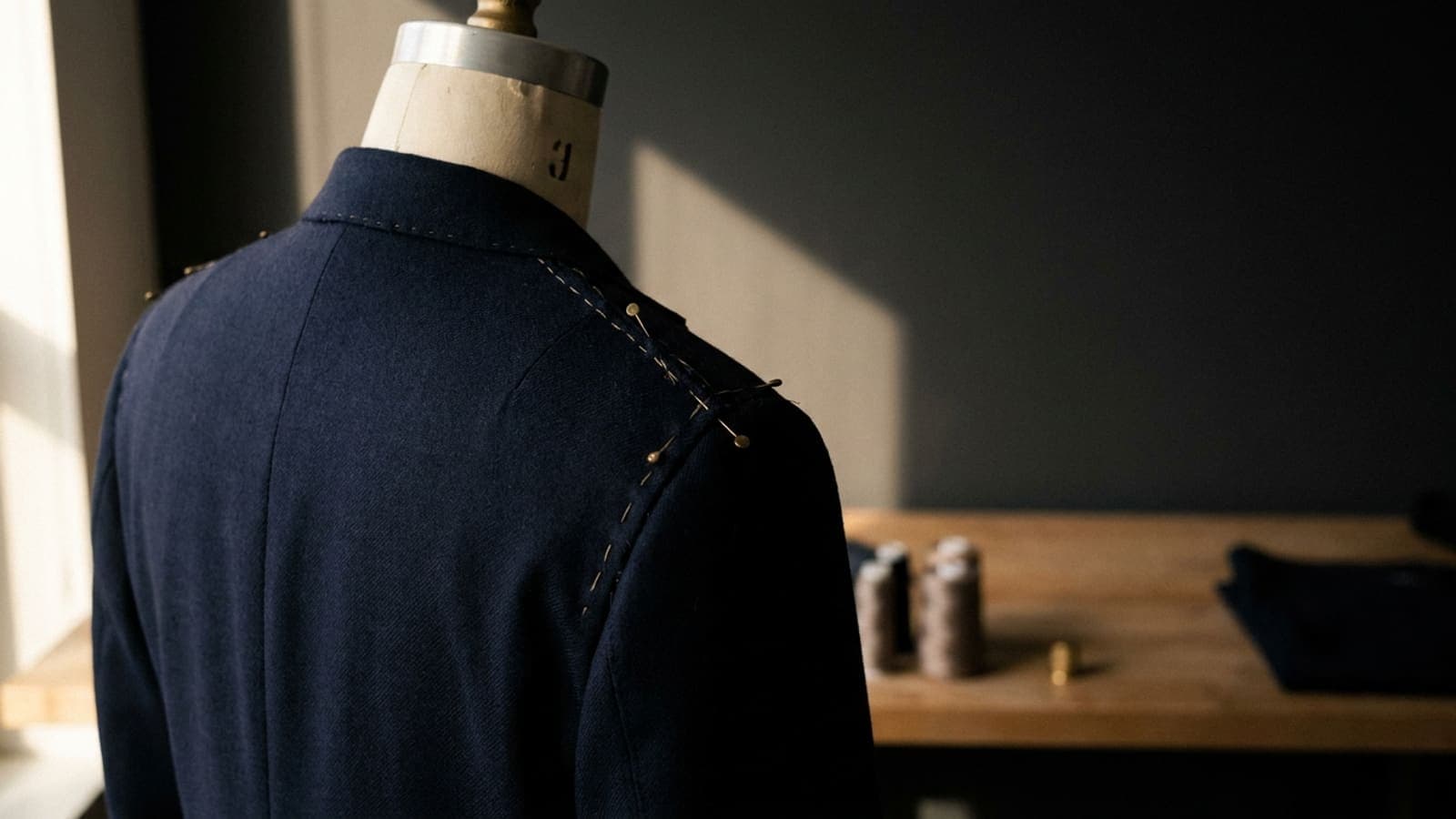
- The basted fitting arrives loosely stitched together in white basting thread, deliberately provisional and deliberately ugly. Because nothing is committed, balance, drape and shoulder can all still be moved. This is the fitting that decides whether the garment will be good
- The forward fitting is the last appointment before delivery. By then we are refining rather than solving — sleeve length, trouser break, the small final things
The basted fitting looks worse than anything you would ever wear. That is exactly why it works — nothing is committed, so everything can still change.
Why the hand, still
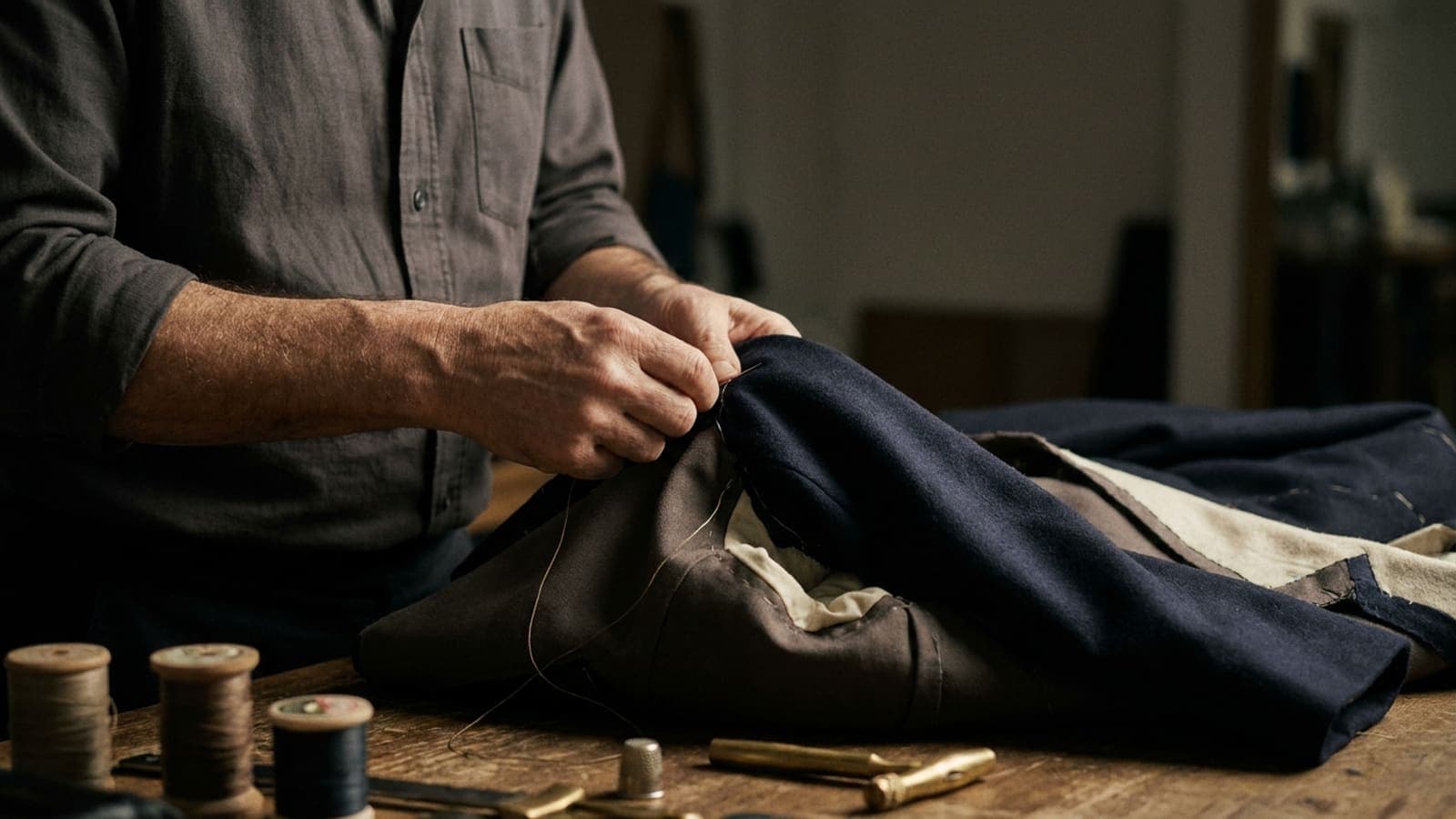
The honest answer is that the machine is better at some things and worse at others, and the craft has kept the hand exactly where the hand wins.
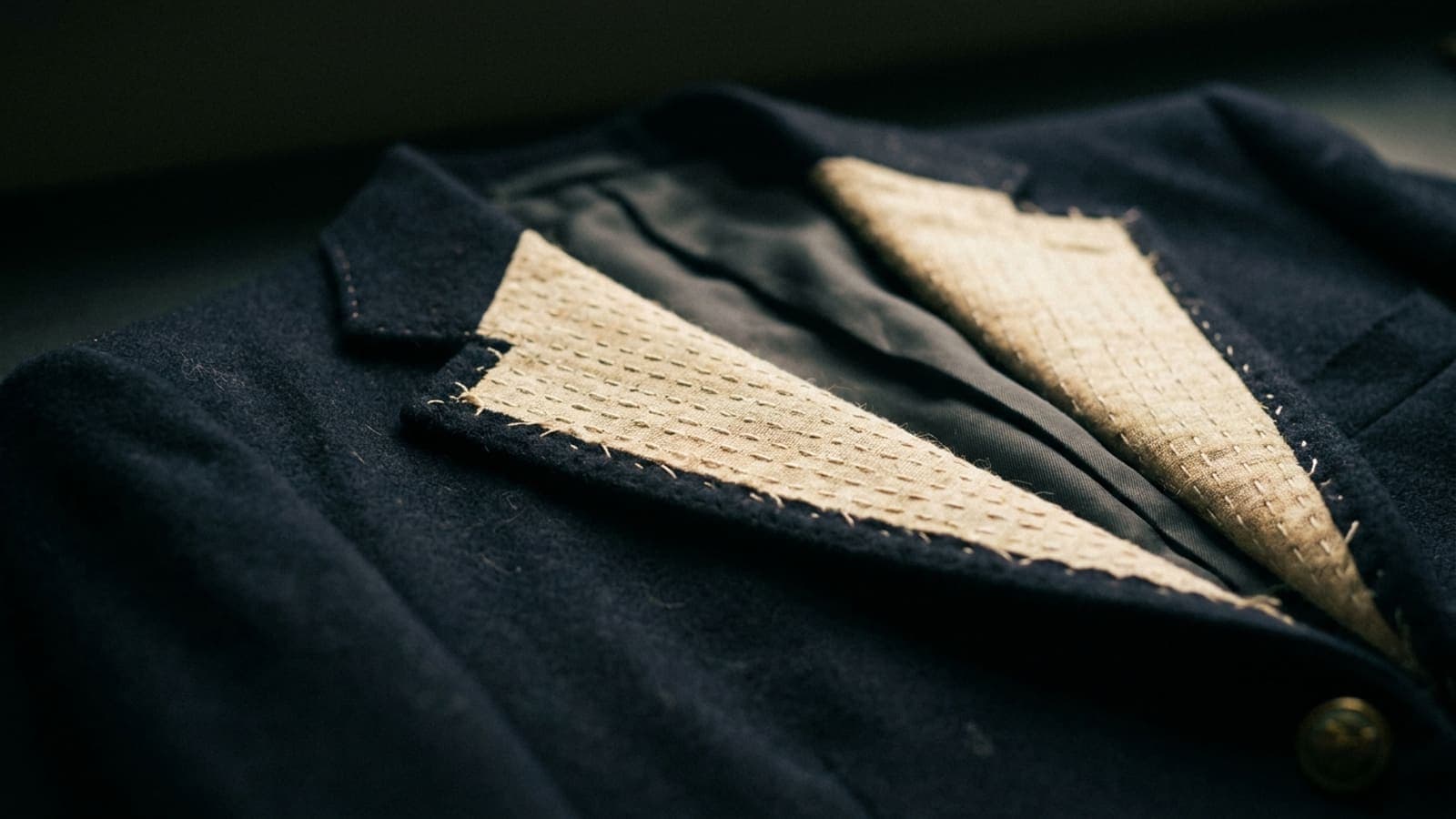
A machine sews a straight seam faster, stronger and more evenly than any person. Nobody is stitching a trouser side seam by hand out of romance. But a machine applies uniform tension, and a great deal of tailoring depends on tension that is deliberately not uniform. Easing a sleeve head into an armhole means placing surplus fabric where it is wanted and withholding it where it is not. Shaping a canvas to a chest means working three-dimensionally into a flat material. Padding a lapel so that it rolls rather than folds is a matter of a few thousand small stitches, each pulled slightly differently.
Hand-stitching also flexes. A hand-worked seam has a small amount of give built into it, so it moves with the wearer and recovers instead of straining. That is why hand-finished garments last, and it is why one that has been worn for twenty years can still look right.
Finished is not the same as finished with
A garment leaving the workroom is not the end of it. Bodies change — the same client at fifty is not the same client at forty — and a well-made jacket has inlay in the seams precisely so it can follow. We maintain what we make for as long as it is worn, and for clients on the Everything Capsule Wardrobe that maintenance runs for the life of the garment.
That is the part I would most want understood about craftsmanship, and it is the least photogenic. It is not a flourish applied at the end. It is a set of decisions made early — real canvas, generous inlay, a pattern worth keeping — that only pay off years later, to someone who is no longer thinking about the day they bought it.
If you would rather see the work than read about it, come by. We are on W. Johnson Street, Tuesday to Saturday, 10:30 to 5, and there is usually something on the table worth looking at.